Variable Frequency Drive (VFD): Complete Buyer's Guide for Industrial Applications
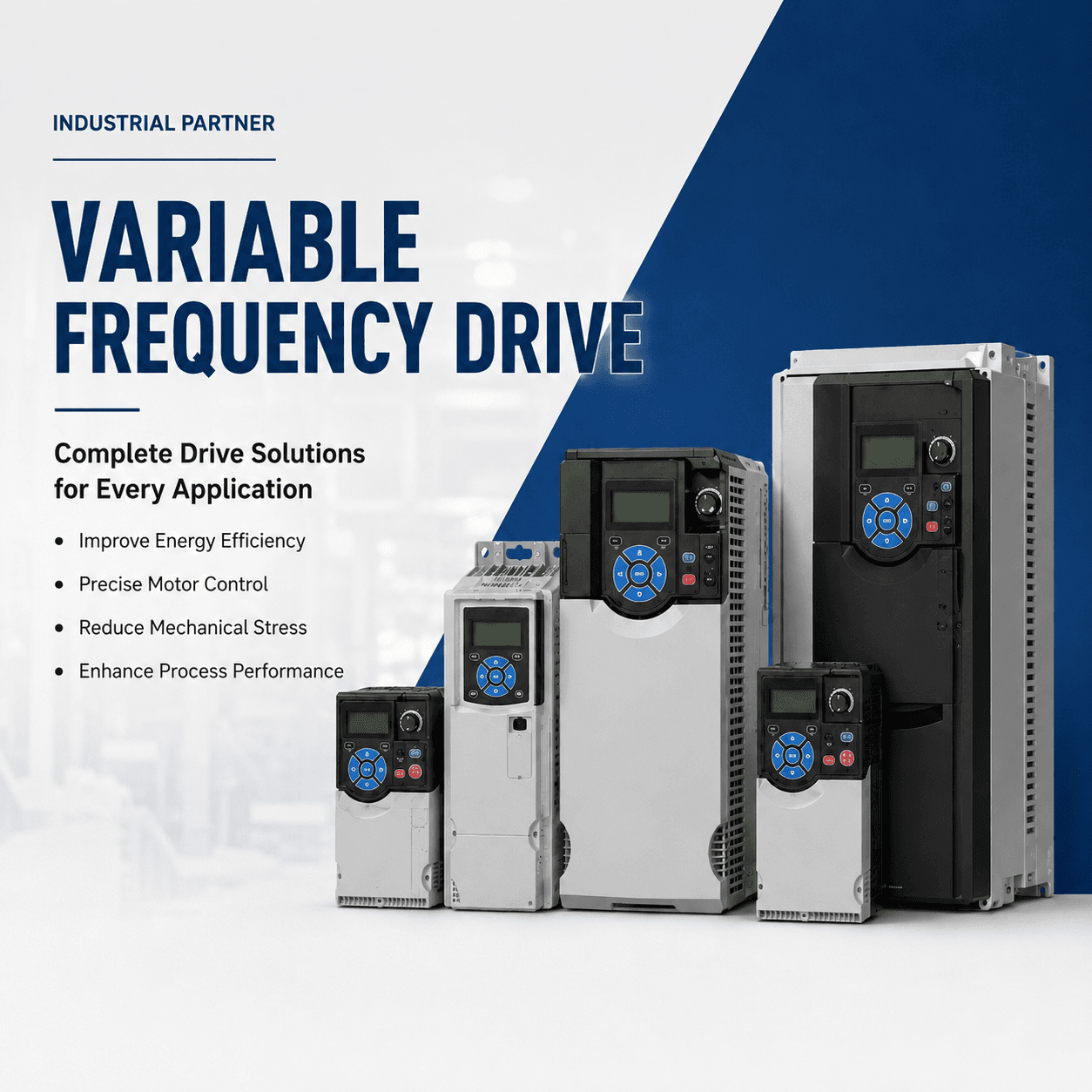
A variable frequency drive is one of the most impactful components in any industrial motor control system. By adjusting the frequency and voltage supplied to an AC motor, a VFD allows precise speed control, reducing energy consumption, extending equipment life, and enabling the kind of process flexibility that fixed-speed motor starters simply cannot provide.
Whether you are specifying a new drive for a pump, fan, conveyor, or compressor application, replacing a failed unit, or evaluating options for an energy efficiency project, this guide covers everything you need to make the right selection.
Industrial Partner stocks variable frequency drives and industrial motor control components across all major brands. Browse VFDs and drives or request a quote.
How a Variable Frequency Drive Works
A VFD controls the speed of an AC induction motor by varying two parameters simultaneously: the frequency of the electrical supply and the output voltage. Because AC motor speed is directly proportional to supply frequency, a four-pole motor running on 60 Hz operates at approximately 1,750 RPM, and the same motor on 30 Hz runs at approximately 875 RPM , the VFD delivers precise speed control across the motor's full operating range.
Modern variable frequency drives accomplish this through two internal conversion stages:
To maintain consistent motor torque across the speed range, the VFD simultaneously adjusts voltage in proportion to frequency, a relationship known as V/Hz or volts-per-hertz control. More advanced VFDs use vector control or direct torque control (DTC) algorithms for superior dynamic response and torque accuracy.
Where Variable Frequency Drives Are Used
VFDs are deployed wherever variable speed control of an AC motor delivers operational or energy efficiency benefits. The applications are virtually universal across industrial sectors.
Pumps and Fans- The Highest-ROI Application
In pump and fan applications, a variable frequency drive delivers energy savings that typically recover the capital cost of the installation within 12 to 24 months. The reason is the affinity law: power consumption in centrifugal pumps and fans is proportional to the cube of the speed. Reducing pump speed to 80% of full speed reduces power consumption to approximately 51% of full-speed demand. A well-sized VFD on a large pump motor can reduce energy consumption by 30–50% compared to across-the-line operation.
Conveyors and Material Handling
Variable frequency drives provide smooth acceleration and deceleration on conveyors, reducing mechanical shock on belts, gearboxes, and drive components. Programmable acceleration ramps eliminate the high inrush current of across-the-line motor starts, reducing wear and extending equipment life.
Compressors
Variable speed compressors using VFDs match output precisely to demand, eliminating the energy waste of unloaded running that characterizes fixed-speed compressor operation. In compressed air systems — one of the largest energy consumers in industrial facilities — VFD-controlled compressors routinely achieve 15–35% energy reductions.
CNC Machines and Precision Manufacturing
VFDs provide the programmable speed control and torque management that CNC spindles and precision machining operations require. Combined with encoder feedback, modern variable frequency drives can maintain spindle speed accuracy to within fractions of a percent across varying load conditions.
HVAC and Building Systems
Air handling units, cooling tower fans, and chiller pumps in industrial and commercial buildings are major VFD application areas. Building automation systems use VFD speed control to match HVAC output to occupancy and ambient conditions, delivering significant energy savings in large facilities.
Types of Variable Frequency Drives
V/Hz (Scalar) Control Drives
The simplest and most cost-effective VFD type. V/Hz drives maintain a fixed ratio between output voltage and frequency, providing adequate speed control for most pump, fan, and conveyor applications where dynamic response is not critical. These are the standard choice for general-purpose applications.
Sensorless Vector Control Drives
Sensorless vector control drives use mathematical models of the motor to estimate rotor flux and torque without a physical encoder. They deliver significantly better low-speed torque performance and faster dynamic response than V/Hz drives, making them suitable for hoists, extruders, mixers, and applications requiring torque control at low speeds.
Closed-Loop Vector (Flux Vector) Drives
Closed-loop vector drives use an encoder mounted to the motor shaft to provide precise speed and position feedback. They deliver the highest speed accuracy and dynamic performance, making them the choice for servo-like applications, winders, draw frames, and precision process lines where speed regulation to 0.01% or better is required.
Regenerative Drives
Standard VFDs dissipate regenerated energy (from braking or overhauling loads) as heat through a braking resistor. Regenerative drives feed this energy back into the supply network, recovering braking energy that would otherwise be wasted. They are used in cranes, elevators, winding machines, and test stands where significant regenerative energy is available.
How to Select the Right Variable Frequency Drive
Correct VFD selection requires matching the drive's specifications to the motor, the load type, and the installation environment. Getting this wrong results in premature drive failure, inadequate motor control, or voided warranties.
Step 1 — Match Power Rating to Motor FLA, Not Just HP
Size the VFD based on the motor's Full Load Amps (FLA) rating, not simply horsepower. HP varies with voltage and RPM — FLA gives the actual current the drive must supply. Always confirm the motor's nameplate FLA and select a drive rated for that current or above. A common mistake is sizing on HP alone, which can result in an undersized drive for motors with unusual speed-to-torque ratios.
Step 2 — Match Input Voltage and Phase
Confirm the site supply voltage (208V, 230V, 460V, 480V, or 575V for North American installations) and whether the supply is single-phase or three-phase. Most industrial VFDs require three-phase input. Running a three-phase drive on single-phase supply requires derating to approximately 50% of rated output current.
Step 3 — Define the Load Type and Required Control Mode
Variable torque loads (pumps, fans, centrifugal compressors) are the most forgiving — a standard V/Hz drive is appropriate. Constant torque loads (conveyors, extruders, mixers) require a drive rated for constant torque with adequate low-speed torque. High-dynamic applications (hoists, winders, precision machines) require vector control. Specify the control mode requirement before shortlisting drives.
Step 4 — Specify Environmental and Enclosure Requirements
VFD enclosure ratings determine where the drive can be installed. IP20 (NEMA 1) drives are for clean, dry indoor panel installations. IP54 or IP55 (NEMA 12/NEMA 4) drives are for dusty or wet indoor environments. IP66 (NEMA 4X) drives are for outdoor or washdown applications. Installing an IP20 drive in a dusty environment will cause premature failure from contamination of internal components.
Step 5 — Verify Communication Protocol Compatibility
If the VFD must communicate with a PLC or control system, confirm the required fieldbus or industrial Ethernet protocol: Modbus RTU, EtherNet/IP, PROFIBUS DP, PROFINET, DeviceNet, or CANopen. Not all drives support all protocols — check compatibility with your PLC brand before selecting.
Industrial Partner: Our technical team can confirm VFD compatibility with your existing control system and motor specifications. Contact us before placing an order to avoid specification errors.
Leading Variable Frequency Drive Brands
The global VFD market is served by a wide range of manufacturers spanning enterprise-grade platforms and cost-effective general-purpose solutions. The leading brands with which industrial facilities most commonly need sourcing support include:
Schneider Electric Altivar — individual series linked:
• ATV12 · ATV320 · ATV630 · ATV930
Mitsubishi Electric FREQROL — series linked with application context:
• FR-A series (high performance) · FR-F series (fan and pump) · FR-E series (compact general-purpose)
Yaskawa — series linked with use-case descriptions:
• V1000 (compact general-purpose) · A1000 (high-performance vector) · GA800 (current-generation industrial drive)
Browse variable frequency drives and industrial motor control components at Industrial Partner, including replacement drives for discontinued models.
Sourcing Replacement Variable Frequency Drives
When a VFD fails in an active production system, the replacement sourcing decision is more complex than simply ordering the same model number. Several factors must be confirmed before placing an order:
Conclusion
A variable frequency drive is one of the highest-leverage components in industrial motor control — delivering energy savings, process flexibility, and equipment protection that fixed-speed starters cannot match. Selecting the right drive requires matching power rating, control type, enclosure, and communication protocol to the specific application. Sourcing a replacement under emergency conditions requires confirmed stock availability, parameter backup capability, and technical expertise in cross-referencing discontinued models.
Industrial Partner stocks variable frequency drives across all major brands — ABB, Siemens, Rockwell PowerFlex, Schneider Altivar, Mitsubishi FREQROL, and Yaskawa — including replacement units for discontinued models. Browse drives or request a quotefor urgent sourcing.