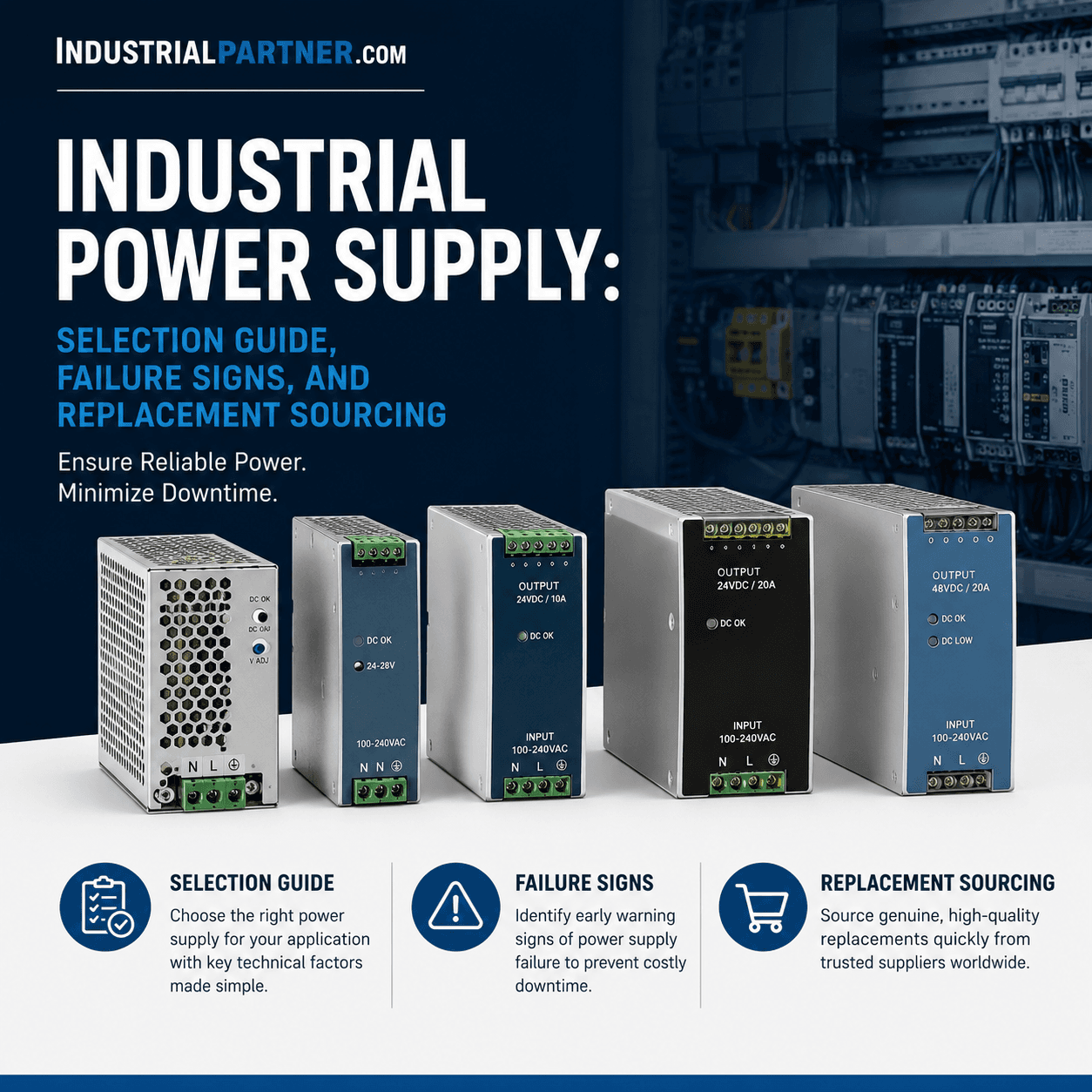
Industrial Power Supply: Selection Guide, Failure Signs, and Replacement Sourcing
The industrial power supply is one of the most critical, and most frequently overlooked, components in any automation panel. It converts incoming AC mains voltage into the regulated DC voltage that PLCs, I/O modules, sensors, relays, HMIs, and communication devices depend on to operate. When an industrial power supply fails, everything downstream stops simultaneously.
Despite their importance, power supplies are often treated as commodity components until a failure occurs. In reality, selecting the right unit, recognizing early failure signs, and having a sourcing strategy for fast replacement are as important as any other element of your automation maintenance program.
This guide covers the selection criteria, failure modes, leading brands, and replacement sourcing considerations for industrial power supplies used in automation and control panel applications.
Industrial Partner stocks DIN-rail and panel-mount industrial power supplies from leading brands including Siemens, Phoenix Contact, Puls, Schneider Electric, and Allen-Bradley, including replacement units for discontinued models. Browse power supplies or request a quote.
What an Industrial Power Supply Does
Industrial DIN-rail power supplies perform three core functions in an automation panel:
Unlike consumer power supplies, industrial units are designed for continuous 24/7 operation over service lives of 10 years or more, wide ambient temperature ranges (typically –25°C to +70°C), and high levels of electrical noise and vibration common in industrial environments. They carry certifications for hazardous location installation (UL, cUL, CE, ATEX) and are rated to recognized safety standards (IEC 60950, IEC 62368).
Types of Industrial Power Supplies
Standard DIN-Rail Power Supplies
The most widely deployed format in industrial automation. Standard DIN-rail units mount directly on the IEC 60715 35mm DIN rail that runs horizontally inside most control panels, alongside circuit breakers, relays, and terminal blocks. They are available in output currents from 1A to 40A at 24VDC, with housings sized proportionally to output power. Siemens SITOP, and Schneider Electric Phaseo are the most widely specified brands globally.
Redundant Power Supply Systems
In systems where power supply failure cannot be tolerated, redundant configurations use two power supply units feeding a common output bus through an OR-ing diode module (decoupling unit). If one supply fails, the other continues to power the load without interruption. This architecture is standard in safety-critical and high-availability applications including process control, water treatment, and railway signalling.
True redundant supplies require matched output voltages to ensure correct load sharing — the Siemens SITOP PSE200U and Phoenix Contact QUINT-DIODE are purpose-designed OR-ing modules for this application.
UPS (Uninterruptible) Power Supplies
Industrial UPS modules extend panel power supply functionality with battery backup, maintaining DC output for a defined period after mains power loss. They are used where the controlled process or PLC program must complete an orderly shutdown sequence, or where brief power interruptions (under one second) would cause unacceptable process disruption.
Wide Input Range Power Supplies
Standard industrial power supplies accept universal AC input (85–264VAC). For applications with highly unstable or unreliable mains supply — common in Africa, the Middle East, and Southeast Asia — wide input range models extending to 340–550VAC three-phase input or incorporating active power factor correction and extended hold-up time provide additional resilience against supply quality variations.
How to Select an Industrial Power Supply
Calculate the Required Output Current
Add the maximum current consumption of all 24VDC loads in the panel — PLC CPU, I/O modules, HMI, relays, solenoids, sensors — at their peak demand. Apply a 20–30% derating factor to this total to select the power supply output current rating. Undersizing causes the supply to run at or near rated capacity continuously, accelerating thermal aging of internal components and reducing service life.
Confirm Input Voltage and Frequency
Most modern DIN-rail industrial power supplies accept universal AC input from 85VAC to 264VAC at 47–63Hz, making them compatible with both 110V (USA/Canada) and 230V (Europe/Africa/Asia-Pacific) supply systems from the same unit. Always verify the nameplate of the supply to be replaced — some older or specialized units are rated for specific voltage ranges only.
Assess the Environment and Installation Requirements
Consider the ambient temperature range, altitude (high altitude reduces cooling effectiveness in convection-cooled units), and available panel space. High-output supplies (20A and above) typically require additional clearance around the unit for convective cooling. In tight panel installations where space is premium, evaluate high-density units such as the Puls DIMENSION series or Phoenix Contact QUINT POWER, which achieve higher output current in narrower housings.
Evaluate Protection and Diagnostic Features
Better-quality industrial power supplies include features that justify their cost premium over entry-level units:
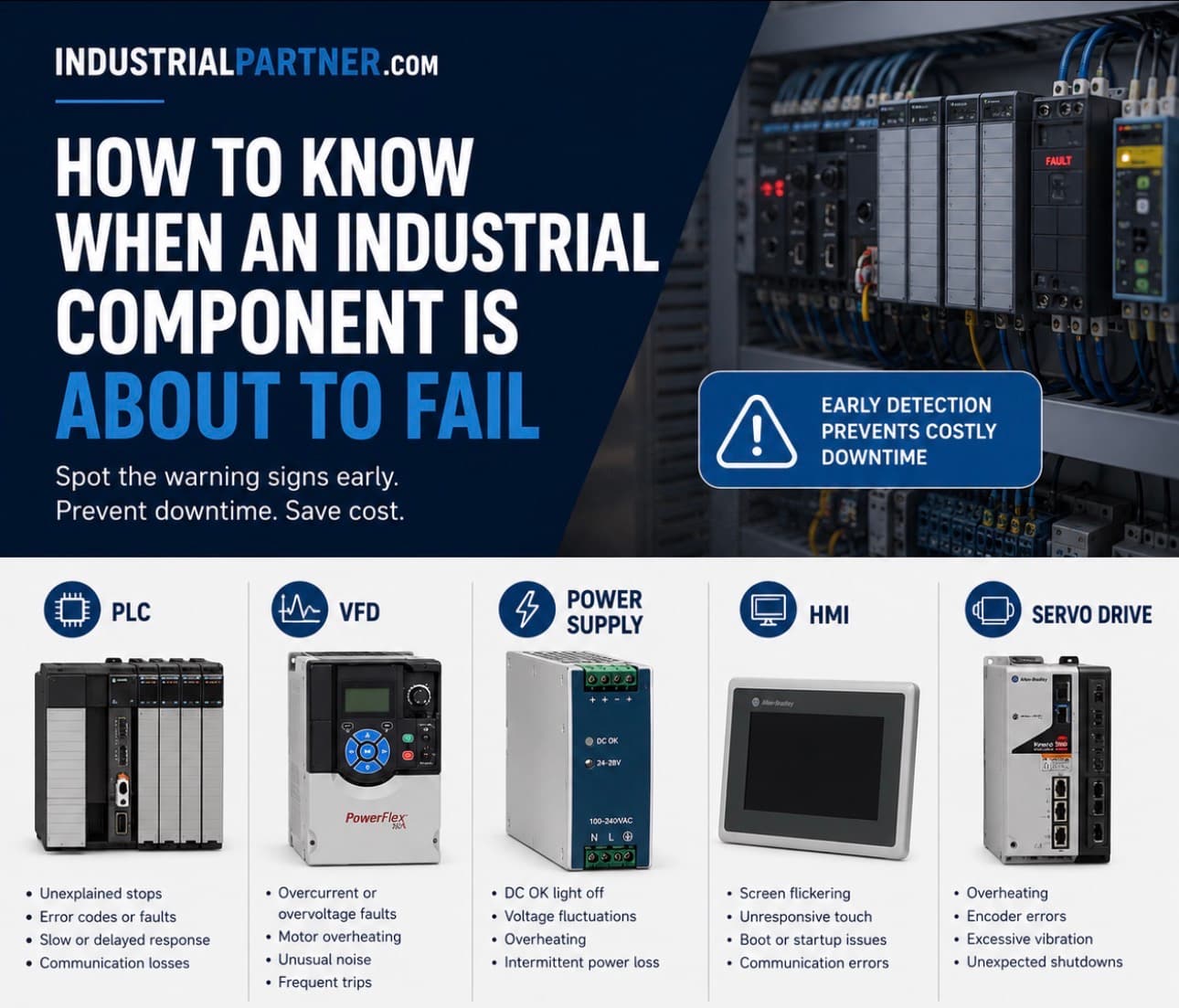
Industrial Power Supply Failure Modes and Early Warning Signs
Industrial power supplies fail for predictable reasons. Understanding these failure modes enables proactive maintenance that prevents unplanned shutdowns.
Capacitor Degradation (The Leading Failure Mode)
Electrolytic capacitors are the life-limiting component in most industrial power supplies. They degrade through charge cycling and thermal stress, gradually losing capacitance and increasing equivalent series resistance (ESR). As capacitors degrade, the supply's output ripple increases, hold-up time decreases, and voltage regulation worsens. Capacitor failure can be gradual (increased output noise causing PLC communication errors before complete failure) or sudden.
Most industrial power supply manufacturers rate capacitor service life at 50,000 hours (approximately 6 years) at full rated temperature. Operating at lower ambient temperatures significantly extends this. For critical applications, proactive replacement of power supplies at 6–8 years is common practice in facilities with rigorous reliability programs.
Fan Failure in Cooled Units
High-power industrial power supplies (typically 20A and above) use internal cooling fans to maintain internal component temperatures within rated limits. Fan bearing failure — which can be detected by increasing noise, vibration, or a rise in supply surface temperature — will eventually cause the supply to overheat and go into thermal shutdown. Most quality supplies have internal thermal protection that shuts down safely rather than causing a catastrophic failure, but the result is a production stoppage.
Input Circuit Damage from Surge Events
Lightning-induced voltage spikes and utility switching transients can damage the input rectifier bridge and surge protection components in power supplies not protected by upstream SPDs (surge protection devices). This type of failure is often misdiagnosed as a generic supply failure until the replacement unit fails in the same way, revealing the underlying transient problem.
Output Voltage Drift
Gradual drift of output voltage outside the regulated range — typically caused by component aging — can cause intermittent PLC errors, communication faults, and sensor misreadings before catastrophic supply failure. A regular practice of measuring 24VDC bus voltage at the panel supply output (it should read 24.0–24.5VDC) can identify an aging supply before it causes a shutdown.
Leading Industrial Power Supply Brands
The global market for DIN-rail industrial power supplies is served by a small number of specialized manufacturers whose products dominate specification in industrial automation applications:
Browse industrial power supplies — including discontinued and replacement units — at Industrial Partner.
Conclusion: The Component You Cannot Afford to Overlook
An industrial power supply failure shuts down everything downstream simultaneously — PLC, I/O modules, sensors, HMI, communication devices. Yet power supplies are consistently underprioritized in maintenance inventories and replacement planning, often because their failure is infrequent enough that it never becomes a pattern until it causes a major unplanned shutdown.
The right approach: select quality units with appropriate safety margins, monitor output voltage routinely, plan proactive replacement at 6–8 year service life intervals for critical applications, and maintain at least one spare unit per unique model deployed in production-critical panels.
Industrial Partner stocks industrial power supplies across all major brands and wattage ranges — from Siemens SITOP and Phoenix Contact QUINT to Puls DIMENSION and Allen-Bradley 1606 series — including replacement units for discontinued models. Browse power supplies or request a quote for urgent sourcing needs.